

SKU:
XH-GXNSJ
Category: Thickening Equipment
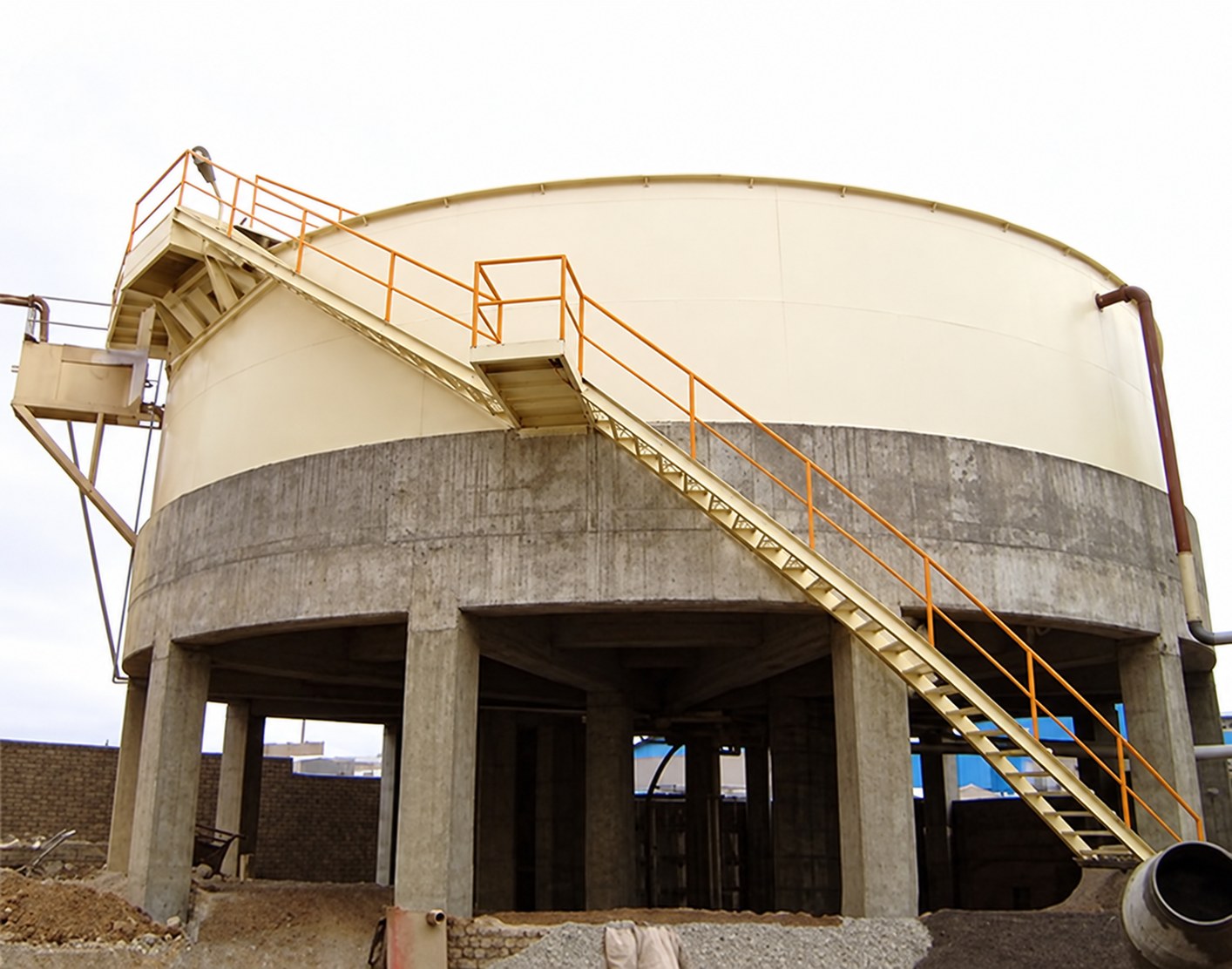
Advantages and Features
- Add flocculant to increase the particle size of settled solid particles, thus speeding up the settling speed
- Add a degassing tank to prevent solid particles from adhering to bubbles
- Equipped with a receiving tray, the feeding cylinder moves downward to make the fed slurry fall evenly and steadily, effectively preventing the occurrence of tumbling
- The unit processing capacity is 4 to 9 times that of conventional concentrators. Calculated based on unit processing capacity, it saves 30% of energy consumption than traditional concentrators
- A flocculant addition system, an automatic control system for flocculant addition, and High-efficiency concentrator automatic control system.
Working Principle
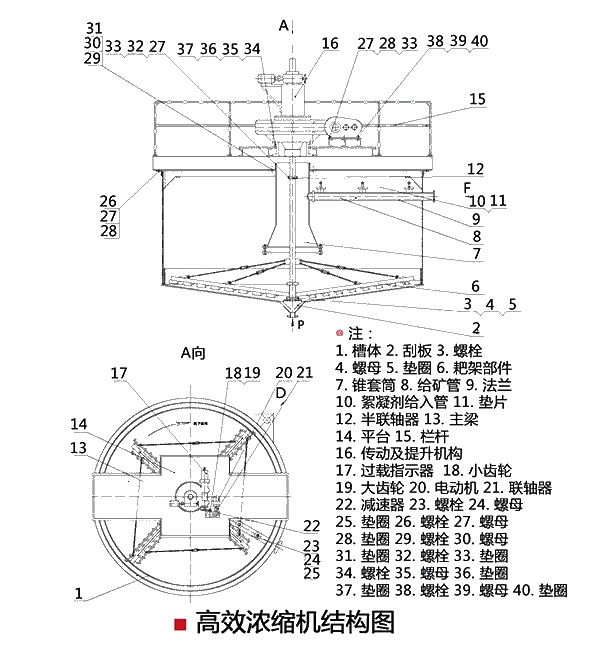
The working principle of the high-efficiency concentrator is that before the slurry enters the high-efficiency concentrator equipment, most of the gas contained in it is removed by the degassing device, and then enters the mixing device from the feeding pipe. The slurry is fully mixed with an appropriate amount of flocculant in the mixing device to form a good flocculation state, and then diffuses from the bottom to the surroundings into the pre-formed high-concentration sediment layer at the bottom of the concentration tank. At this time, the flocculated slurry (flocculation) settles to the bottom of the tank; the slurry water rises through the sediment layer. Here, the sediment layer acts as a filter and prevents fine-grained sludge from rising. The slurry that has not yet been fully flocculated will continue to contact the flocs when it reaches the sediment layer, causing the flocs to continue to grow. Finally, the rake frame is driven by the central driving device, and the concentrated material is pushed to the central discharge port and discharged, and the slurry water flows out from the overflow port.
Technical Specifications
| Model | Tank inner diameter (mm) | Tank height (mm) | Settlement area (m2) | Rake speed (r/min) | Rake lifting height (mm) | Drive motor model | Drive motor power (kW) | Lift motor model | Increase motor power (kW) | Steel tank weight (kg) | Weight(kg) |
|---|---|---|---|---|---|---|---|---|---|---|---|
| GX-3.6 | 3600 | 1700 | 10.2 | 1.1 | 200 | Y100L-6 | 1.5 | Y100L-6 | 1.5 | 2829 | 6650 |
| GX-5.18 | 5182 | 2134 | 21 | 0.4 | 300 | Y132S-6 | 3 | PZ0.8AB | 0.8 | 5342 | 10460 |
| GX-6 | 6000 | 2500 | 28.3 | 0.8 | 300 | Y132M1-6 | 4 | Y132S-8 | 2.2 | 6506 | 10573 |
| GX-7.5 | 7500 | 2800 | 44.1 | 0.427 | 300 | Y132M2-6 | 5.5 | Y132S-8 | 2.2 | 10258 | 17320 |
| GX-9 | 9000 | 2800 | 63.6 | 0.427 | 300 | Y132M2-6 | 5.5 | Y132S-8 | 2.2 | 15980 | 23680 |
| GX-12 | 12000 | 3600 | 110 | 0.35 | 300 | Y132M-4 | 7.5 | Y100L1-4 | 2.2 | 25589 | 42756 |
| GX-15 | 15000 | 4000 | 177 | 0.15 | 300 | YCT200-4B | 7.5 | Y112M-6 | 2.2 | 36050 | 59000 |
| GX-18 | 18000 | 4400 | 254 | 0.13 | 400 | YCT200-4B | 7.5 | YTC752A-44 | 5.5 | 52485 | 73296 |
| GX-20 | 20000 | 4400 | 314 | 0.13 | 400 | YCT200-4B | 7.5 | YTC752A-44 | 5.5 | 59365 | 76020 |
Case Study
During the concentration process of a certain mineral processing plant, an additional chemical system is required, which not only increases costs but also increases losses. The high-efficiency concentrator can provide a flocculant and other pharmaceutical addition system, and the supporting role between facilities is more obvious. In addition, the new mechanical structure increases the flocculation effect of the flocculant on solid particles. While being convenient and efficient, it also controls costs to a certain extent.